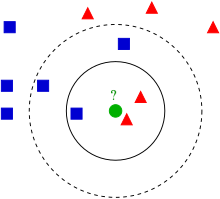
When you want to classify a data point into a category like spam or not spam, the KNN algorithm looks at the K closest points in the dataset. These closest points are called neighbors.
^ a b Mirkes, Evgeny M.; KNN and Potential Energy: applet Archived 2012-01-19 at the Wayback Machine, University of Leicester, 2011 ^ Ramaswamy, Sridhar; Rastogi, Rajeev; Shim, Kyuseok (2000). "Efficient algorithms for mining outliers from large data sets". Proceedings of the 2000 ACM SIGMOD international conference on Management of data ...
The k-nearest neighbors (KNN) algorithm is a non-parametric, supervised learning classifier, which uses proximity to make classifications or predictions about the grouping of an individual data point.
kNN, or the k-nearest neighbor algorithm, is a machine learning algorithm that uses proximity to compare one data point with a set of data it was trained on and has memorized to make predictions.
K-nearest neighbors (KNN) algorithm is a type of supervised ML algorithm which can be used for both classification as well as regression predictive problems. However, it is mainly used for classification predictive problems in industry.
K-nearest neighbor (KNN) is a non-parametric, supervised machine learning algorithm that classifies a new data point based on the classifications of its closest neighbors, and is used for classification and regression tasks.
KNN classifies or predicts outcomes based on the closest data points it can find in its training set. Think of it as asking your neighbors for advice; whoever’s closest gets the biggest say.
The k-nearest neighbors (KNN) algorithm offers a straightforward and efficient solution to this problem. Instead of requiring complex calculations up front, KNN works by storing all the data and then making predictions for new data based on how similar it is to existing data.
KNN works by evaluating the local minimum of a target function to approximate an unknown function with the desired precision and accuracy. The algorithm identifies the “neighborhood” of a new input (e.g., a new data point) by assessing its distance to known data points.